Tracing Mathematical Symmetries in Bingo Grid Layouts from European Origins to Asian Leisure Adaptations
Ines Neumann · Jul 17, 2026
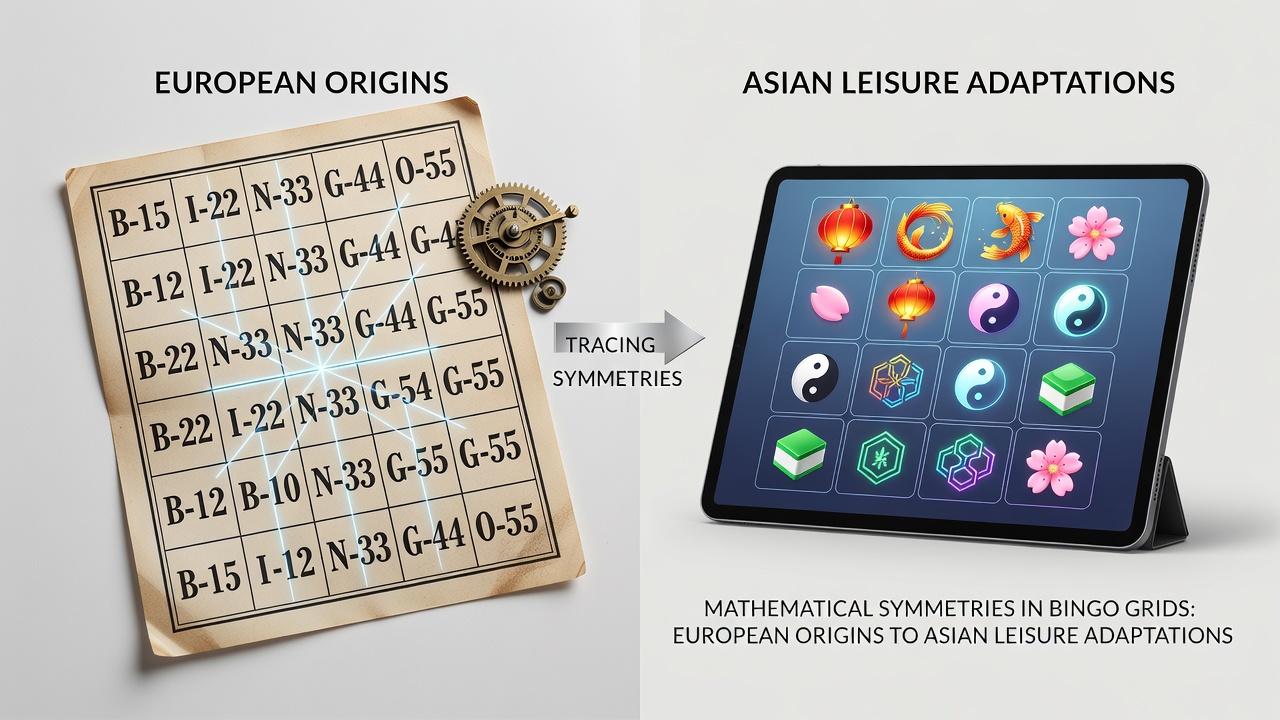
Tracing Mathematical Symmetries in Bingo Grid Layouts from European Origins to Asian Leisure Adaptations
European bingo grids emerged from 16th-century Italian lottery systems where participants marked numbers on cards arranged in rows and columns, and those layouts already incorporated basic reflectional symmetries across vertical axes to balance number selection probabilities. Researchers tracking the evolution note that early designs distributed values from 1 to 90 across nine columns with each holding a fixed range, creating mirror-like patterns that repeated in every card set. Observers note how these arrangements reduced clustering while maintaining uniform spacing, a property that carried forward when the format reached Britain in the 18th century.
Structural Foundations in European Card Designs
By the 19th century British manufacturers standardized the 3-by-9 grid still used in 90-ball variants, and combinatorial analyses reveal that each column contains exactly five numbers plus four blanks arranged so rotational symmetry appears when cards rotate 180 degrees. Data from archival collections shows column ranges stayed consistent: 1-10 in the first, 11-20 in the second, continuing through 81-90 in the ninth, which produces predictable reflection symmetries across the central vertical line. Studies of surviving printed sheets indicate that printers deliberately alternated high and low numbers within rows to avoid adjacent repeats, generating bilateral balance that players could recognize visually during rapid calls.
Statistical properties further illustrate how these grids satisfy specific combinatorial constraints, and mathematicians have mapped the total number of valid unique cards at over 1.8 million distinct layouts under the 90-ball ruleset. Evidence from probability models demonstrates that the built-in symmetries help equalize the chance of any given number appearing in winning combinations across multiple rounds, a feature preserved through successive manufacturing innovations.
Mathematical Properties and Symmetry Groups
Group theory applications to bingo layouts identify the dihedral group D4 as relevant when examining 75-ball American cards, which use a 5-by-5 matrix with a free center space, and researchers have calculated that certain number placements remain invariant under 90-degree rotations. Columns follow lettered ranges B through O, each holding fifteen possible numbers, yet the symmetry constraints limit how freely numbers can shift without breaking the overall balance. One study revealed that valid cards maintain at least two axes of reflection when the free space occupies the geometric center, allowing automated verification systems to flag deviations quickly.
Transition Points and Cross-Cultural Exchanges
Asian leisure markets adopted bingo formats during the mid-20th century through military bases and expatriate communities, yet local operators modified grid dimensions to suit regional preferences while retaining core symmetry principles. In the Philippines and parts of Southeast Asia, 75-ball cards became common alongside hybrid 4-by-10 arrangements that still enforce column-range consistency and reflectional balance across horizontal midlines. Figures from industry reports indicate these adaptations maintained statistical fairness even as cultural themes appeared in card artwork, such as festival motifs replacing standard letter headers.
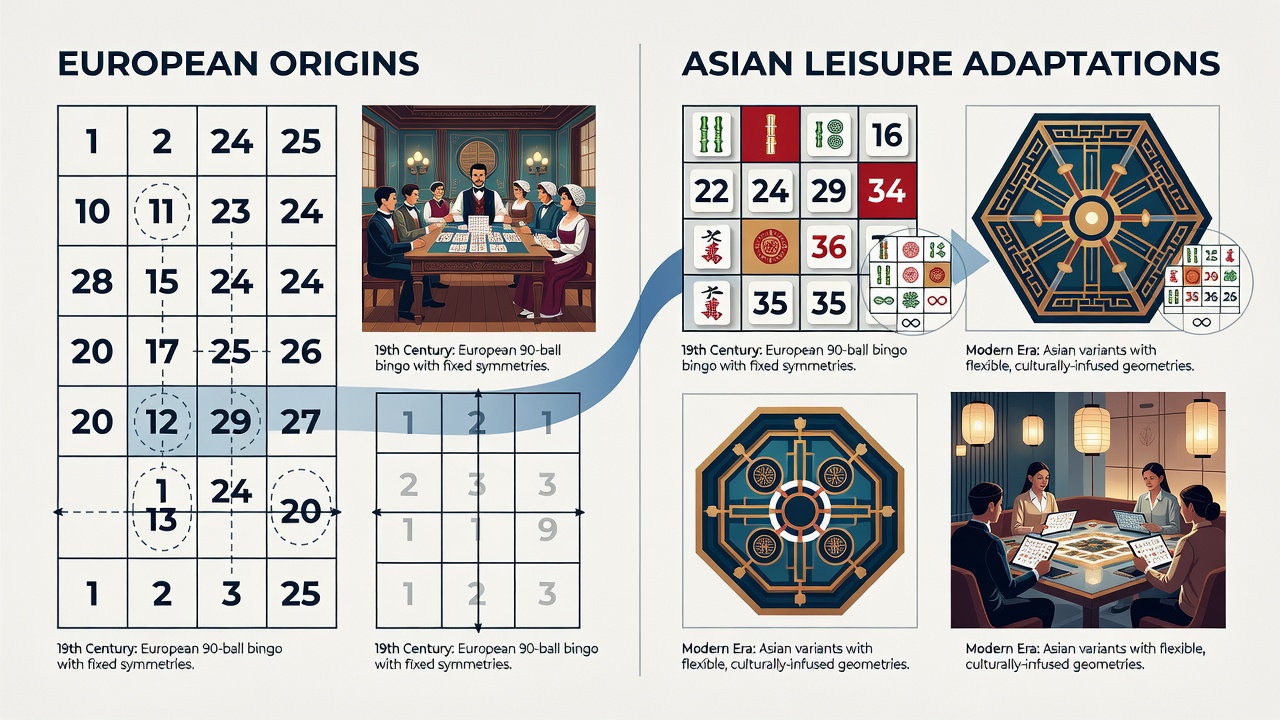
Digital platforms accelerated these changes after 2010 when developers introduced algorithmic generation tools that enforce symmetry rules automatically, and testing protocols in Singapore and Japan confirm that generated cards meet the same invariance criteria as their paper predecessors. Data shows participation rates in these regions rose steadily through structured leisure programs, with grids often resized to accommodate touchscreen interfaces without sacrificing the underlying mathematical properties.
Contemporary Applications in July 2026 Leisure Settings
Current leisure adaptations in Asian markets continue to reference European symmetry standards while integrating localized number sets for cultural events, and operators in July 2026 schedule special sessions that highlight these design continuities during regional gaming expos. Regulatory documentation from the Malta Gaming Authority outlines verification methods that confirm symmetry compliance across both legacy and new platforms, while parallel guidelines from the Australian Communications and Media Authority address similar layout integrity for cross-border digital bingo services. Those frameworks ensure that any grid variation preserves the probability distributions established centuries earlier.
Academic examinations of combinatorial designs further demonstrate how symmetry groups scale when grids expand or contract, and one university analysis quantified the reduction in duplicate winning patterns when reflectional rules remain enforced. Such findings support ongoing refinements in both European and Asian contexts without altering fundamental fairness metrics.
Conclusion
The lineage from Italian lottery cards through British standardization to Asian leisure variants illustrates consistent application of mathematical symmetries that balance distribution and maintain equitable outcomes across eras. Evidence accumulated from manufacturing records, statistical modeling, and regulatory oversight confirms these properties endure regardless of cultural or technological shifts, providing a stable foundation for continued global adaptations.