Random Number Generators: Their Critical Function in Securing Fair Outcomes for Digital Bingo Participants Worldwide
Ines Neumann · Jun 26, 2026
Random Number Generators: Their Critical Function in Securing Fair Outcomes for Digital Bingo Participants Worldwide
Random number generators form the backbone of digital bingo systems that operate across continents, and they deliver the sequence of numbers called during each game while maintaining statistical independence from previous draws. These algorithms process inputs through complex mathematical functions that produce outputs indistinguishable from true randomness in practical applications, which ensures every participant receives an equal opportunity regardless of location or device used.
Core Mechanisms Behind Digital Draws
Modern bingo platforms rely on two primary categories of generators, including pseudorandom number generators seeded by system entropy sources and hardware-based true random number generators that harvest physical phenomena such as thermal noise or quantum fluctuations. Pseudorandom systems employ algorithms like the Mersenne Twister or Fortuna, which expand an initial seed value into long sequences that pass rigorous statistical test suites developed by organizations including the National Institute of Standards and Technology. Hardware solutions integrate dedicated chips that capture unpredictable physical events, and they feed those measurements directly into the bingo software stack without intermediate storage that could introduce patterns.
Certification bodies evaluate these implementations against published standards that require minimum entropy levels, resistance to prediction, and documented procedures for periodic reseeding. In June 2026 several international testing laboratories released updated compliance frameworks that incorporated new benchmarks for post-processing techniques used in high-volume multiplayer environments.
Ensuring Equity Across Global Networks
Digital bingo operators deploy generators that undergo continuous monitoring through automated logging systems that record every output sequence alongside timestamps and session identifiers. Independent auditors review these logs at scheduled intervals to confirm that distribution remains uniform across the full range of possible numbers, typically 1 through 75 or 1 through 90 depending on the regional variant. When deviations exceed established thresholds, platforms trigger immediate shutdown protocols that halt play until replacement hardware or software passes fresh validation.
Regulatory frameworks in North America, the European Union, and the Asia-Pacific region mandate that operators publish summary statistics demonstrating fairness metrics on a quarterly basis. Data compiled by gaming control authorities shows that certified systems maintain deviation rates below 0.01 percent across millions of draws, a level that satisfies both statistical and legal requirements for equitable participation.
Integration with Platform Architecture
Developers embed random number generator outputs into bingo engines through application programming interfaces that isolate the generation process from user interfaces and payment modules. This separation prevents any single component from influencing draw results, while cryptographic hashing protects the integrity of transmitted sequences between servers and client devices. Multiplayer sessions synchronize generator states across distributed data centers using consensus protocols that eliminate timing discrepancies capable of creating perceived bias.
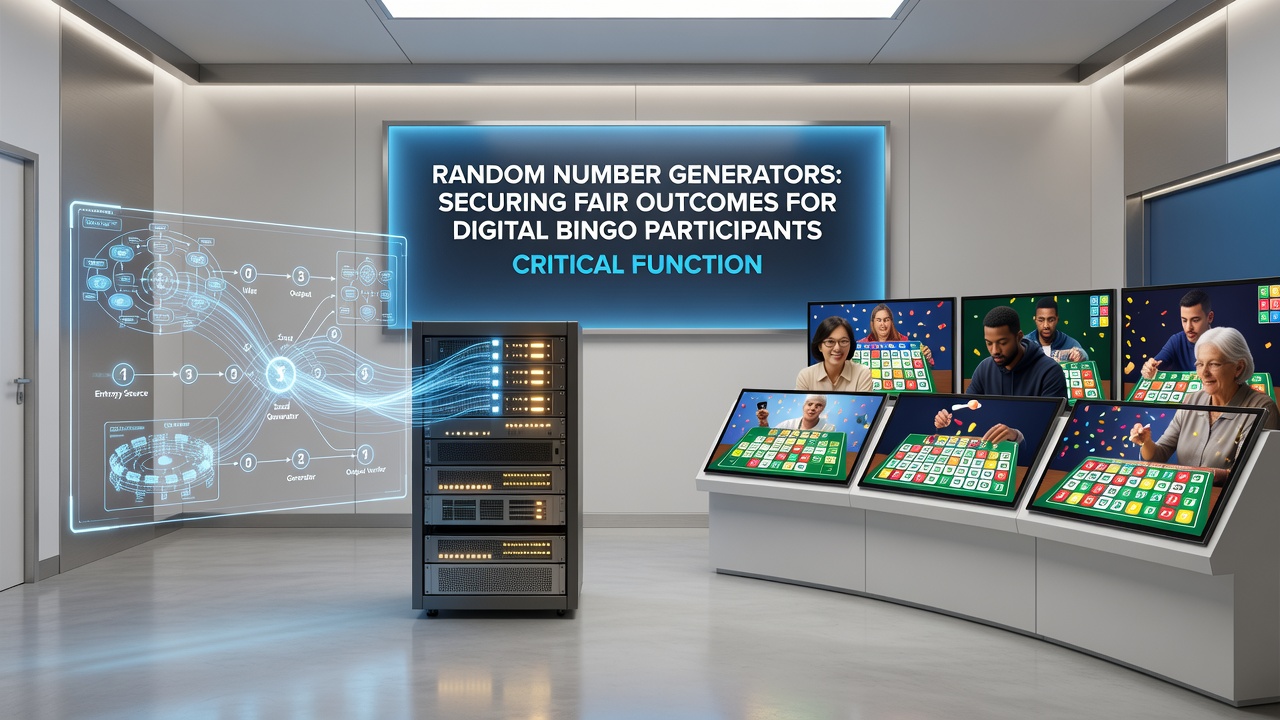
One study conducted at a European technical university examined generator performance under simulated peak loads equivalent to 500,000 concurrent players and found that properly implemented systems maintained output uniformity without measurable degradation. Observers note that such resilience proves essential during major events when participation spikes dramatically.
Addressing Emerging Technical Challenges
Quantum computing advances have prompted research institutions to develop post-quantum cryptographic standards that protect generator seeds against future brute-force attacks. Several jurisdictions now require operators to demonstrate readiness for these standards through phased migration plans submitted to oversight agencies. At the same time, artificial intelligence tools assist auditors in scanning output streams for subtle correlations that traditional statistical tests might overlook, and they flag anomalies for human review within minutes rather than days.
Industry reports from the Asia-Pacific region indicate that adoption of quantum-resistant generators increased by 18 percent between 2024 and 2026 among licensed bingo platforms. This shift aligns with broader efforts to future-proof digital gaming infrastructure against evolving computational threats while preserving the core guarantee of fair outcomes.
Conclusion
Random number generators continue to underpin trust in digital bingo by supplying the impartial sequences that determine winners across worldwide player bases. Through layered testing, regulatory oversight, and ongoing adaptation to new technologies, these systems sustain the statistical fairness that participants expect when joining games from any location. Continued collaboration between standards organizations, laboratories, and operators ensures that the mechanisms remain robust as participation volumes and technical landscapes evolve.